What Nobody Told You About Online Jobs
Wondering how online jobs work? This beginner-friendly guide breaks down the mechanics, key players, tools, payment methods, and first steps for Nigerians.
You have probably heard someone say it — “I work online and I get paid in dollars.” Maybe it was a cousin in Enugu, a contact on LinkedIn from Lagos, or someone in a WhatsApp group you nearly left. And your first reaction was either excitement or scepticism. Possibly both.
The concept of online jobs has been floating around Nigeria for years, but for many beginners, it still feels like a mystery. Not because it is complicated — it is actually not. The real problem is that most explanations either go over your head with jargon or gloss over the parts that actually matter to someone just starting out.
This article is different. We are going to break down exactly how online jobs work — from the moment a skill meets the internet to the moment money lands in your account. No fluff. No unnecessary complexity. Just a clear, honest explanation written specifically for Nigerians and global beginners who want to understand the process before jumping in.
Understanding how online jobs work is important for one simple reason: you cannot succeed at something you do not understand. Many beginners fail not because they lack skill, but because they misunderstand the mechanics. They sign up on the wrong platforms, price themselves poorly, wait for jobs that never come, or get confused about how to collect payment. All of that becomes avoidable once you understand the system.
If you are new to this space and want a broad starting point, we recommend reading our overview of the 10 Fundamental Methods To Make Money Online — online jobs are one of the most reliable entries on that list.
What Are Online Jobs? A Quick Overview
An online job is any form of work you perform using the internet and get paid for — without being physically present at a traditional office. You can do it from your room in Kano, a café in Abuja, or your living room in Port Harcourt. As long as you have a device, an internet connection, and a marketable skill, you are already equipped with the basics.
Online jobs span a wide range of fields and skill levels. Writing, graphic design, virtual assistance, software development, video editing, data entry, customer service, social media management, teaching — these are just a fraction of what the online job market covers. The demand is global, which means your potential clients are not limited to Nigeria. You could be doing work for a company in Canada, the United Kingdom, the United States, or anywhere else in the world.
The fundamental difference between a traditional job and an online job is location. In a traditional job, your physical presence is required. In an online job, your output is what matters — not where you sit when you produce it.
For a deeper dive into the world of online jobs — including the types, categories, platforms, and how to get started — read our comprehensive guide: Online Job: The Complete Beginner’s Guide To Getting Started and Getting Paid.
How Online Jobs Work: The Core Mechanics
Before you start thinking about which type of online job suits you, it helps to understand the basic mechanics — the actual flow of how an online job works from beginning to end.
The process is more straightforward than most people expect.
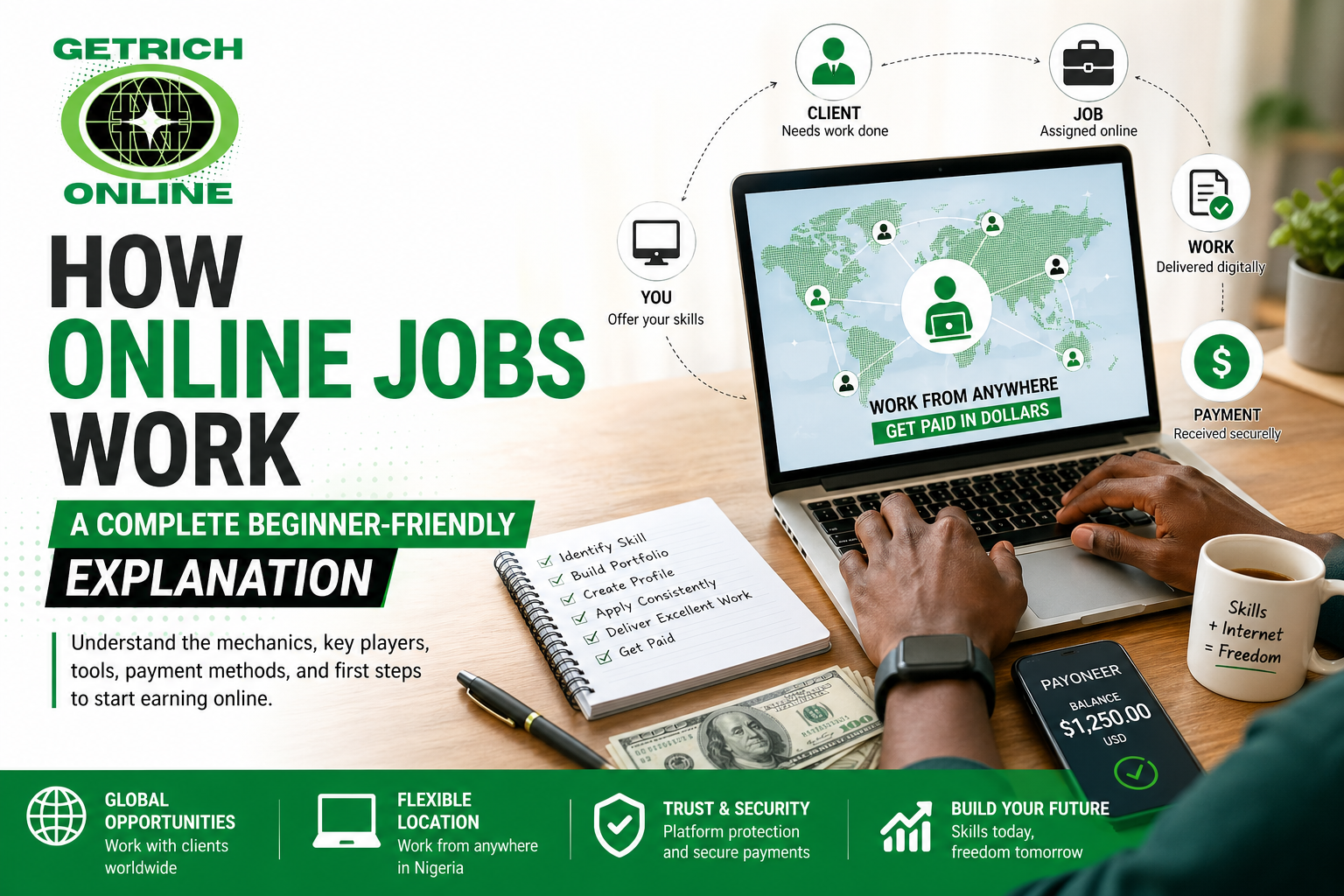
You have a digital skill. You make that skill visible — either by creating a profile on a platform or by marketing yourself through LinkedIn, Twitter/X, or other social media channels. A client or employer finds you, or you find them. They assign you a task or bring you on for an ongoing role. You deliver the work through a digital channel — email, a shared drive, a project management tool, or directly through the platform. The employer reviews and approves the work. You receive payment.
That is the entire cycle. No commute. No oga hovering over your desk. No traffic on Third Mainland Bridge or the Abuja-Keffi Expressway.
What makes this system work is the combination of digital tools and trust signals. Let us look at both.
The Digital Tools Involved
The tools used in most online job arrangements are ones many Nigerians already use daily. You are not required to learn complicated software before you can start working online. Here is what comes up most often:
Email is the primary channel for professional communication, job briefs, and document delivery. If you have a Gmail account, you already have the foundation.
WhatsApp is used by a surprising number of clients — especially those working directly with African freelancers — for quick back-and-forth communication, sending voice notes, and even sharing files.
Google Docs and Google Drive are standard tools for creating, editing, and sharing written documents. Many writing and research jobs happen entirely inside Google Docs.
Zoom and Google Meet are used for virtual interviews, project kick-off calls, client briefings, and weekly check-ins. If a client wants to meet before hiring you, it usually happens on one of these platforms.
Trello, Slack, and Asana are project management and communication tools used by more structured clients and agencies to assign tasks, track progress, and keep teams organized. These have free tiers that are more than sufficient for freelancers.
You do not need to be a technology expert to use any of these tools. They are designed for everyday people, and a brief YouTube tutorial is enough to get comfortable with any of them.
The Key Players in Every Online Job Arrangement
Most online job arrangements involve three parties. Understanding who they are and what role each plays will help you navigate the ecosystem clearly.
The Client or Employer
This is the person or organisation that has a problem to solve or a task to complete — and is willing to pay someone online to do it. A client could be a small business owner in the United Kingdom looking for a social media manager, a startup in Canada that needs a logo designed, an e-commerce brand that needs product descriptions written, or a consulting firm that needs data analysed. Their common thread is that they need remote talent and they are comfortable working online.
The Worker — You
This is your role. You are the person who has a skill, makes it visible online, and exchanges that skill for payment. Your job is to find clients, deliver excellent work, communicate professionally, and build a reputation over time. The stronger your skill and your track record, the better your earning potential.
The Platform
In many online job arrangements, there is a third party — a platform that connects clients to workers and handles the mechanics of the transaction. Platforms like Upwork, Fiverr, Freelancer.com, and Toptal exist specifically to make this connection safe, structured, and reliable. Local platforms like Jobberman also serve this role for workers and employers within Nigeria.
Platforms typically provide a profile system, a messaging interface, a job board, and — critically — a payment system. When a client pays through a platform, the money is often held in escrow until the work is approved, which protects both parties. The platform takes a commission for this service, which is the trade-off you make for access, visibility, and payment security.
Not all online jobs go through platforms. Some workers operate independently — they find clients through LinkedIn, referrals, or their own websites, and they handle payment directly. This is called working with a direct client. Direct client work usually pays better because there is no platform commission, but it requires more effort to find clients and manage the payment process yourself.
How Payment Works in Online Jobs
This is the question most Nigerian beginners are most anxious about — and rightly so, because getting paid from international clients has historically been complicated in Nigeria.
Platform-Based Payment
When you work through platforms like Upwork or Fiverr, payment is handled within the platform. Clients load funds into the platform, and once work is approved, the platform releases your earnings to your account on the platform. You then withdraw to your local payment method.
Most major platforms support withdrawal options that work in Nigeria, including:
- Payoneer — one of the most widely used withdrawal options for Nigerian freelancers. You receive a Payoneer account with a virtual US bank account, which makes it easy to receive dollar payments.
- PayPal — still used on some platforms, though its Nigerian functionality has been limited. You can receive payments but local withdrawal to Nigerian accounts requires a workaround via Payoneer.
- Direct Bank Transfer (Wire Transfer) — some platforms allow direct wire transfer to your Nigerian domiciliary account. This works but often comes with transfer fees.
- Cryptocurrency — some freelancers and clients agree on crypto (usually USDT/stablecoins) as a payment method, especially for direct client arrangements. This is becoming more common among tech-savvy Nigerian freelancers.
Direct Client Payment
If you work with a direct client outside a platform, you will need to agree on a payment method upfront. The most popular options among Nigerian freelancers working with international clients include Payoneer, Wise (formerly TransferWise), and sometimes crypto. For local Nigerian clients, direct bank transfers and payment platforms like Flutterwave or Paystack work well.
The key principle: always agree on the payment method before you start work. This avoids confusion and protects your effort.
How Trust Works in the Online Job World
Trust is the currency that makes online jobs function. Because clients cannot see you physically, and you cannot see them, both parties need some form of assurance.
For clients, trust comes from your profile, portfolio, and reviews. When you have completed jobs and collected positive reviews from previous clients, new clients are more comfortable hiring you. A strong portfolio of past work reinforces this further.
For workers, trust comes from the client’s history on the platform, their communication style, and the security of the payment arrangement. Established clients on platforms like Upwork have a track record of completed projects and worker reviews, which tells you they are legitimate.
When you are starting out, you have no reviews and possibly no formal portfolio. That is completely normal — every experienced online worker started exactly where you are now. The goal at the beginning is not to find the highest-paying jobs immediately. The goal is to complete your first few jobs excellently, deliver ahead of expectation, ask for reviews, and let that growing track record do the work of attracting better clients over time.
Starting with competitive pricing (not embarrassingly low, but accessible) for your first few jobs is a reasonable strategy to get your first reviews on the board.
How Beginners Get Started: A Step-by-Step Overview
If you are ready to move beyond understanding and take your first practical steps, here is how the process typically looks for Nigerian beginners:
Step 1 — Identify Your Skill
What can you do that someone else would pay for? Writing, design, data entry, virtual assistance, coding, video editing, translation, customer service, social media — pick one and focus on it. Do not try to be everything at once when starting out.
Step 2 — Build a Basic Portfolio
Even before your first paid job, you can create sample work that demonstrates your skill. Write three articles, design two mock social media graphics, create a sample data spreadsheet. These become the foundation of your portfolio.
Step 3 — Create Your Profile
Choose the platform most aligned with your skill and create a complete, professional profile. Use a clear photo, write a focused bio that speaks directly to what you offer, and upload your portfolio samples.
Step 4 — Start Applying
On platforms like Upwork, you apply to jobs posted by clients using a proposal. On Fiverr, clients find you through your listed service (called a “Gig”). Start applying consistently, and refine your proposal based on feedback over time.
Step 5 — Deliver Excellent Work
When you land your first job, treat it as your most important job ever — because it is. An excellent first job leads to a review, which leads to the next job, which leads to a growing reputation.
Step 6 — Set Up Your Payment
Create your Payoneer account (or whichever payment method your platform supports) before you start, not after you earn. This ensures there is no delay when it is time to receive your money.
Common Mistakes Beginners Make With Online Jobs
Knowing what not to do is just as valuable as knowing what to do. Here are the most common pitfalls Nigerian beginners fall into:
Trying to do too many things at once. Spreading yourself across five different skills and ten different platforms leads to poor results on all of them. Pick one skill. Master one platform first.
Underpricing to the point of attracting bad clients. There is a difference between competitive pricing and desperation pricing. Clients who pay almost nothing tend to demand the most and give the worst reviews.
Not reading job descriptions carefully. Many beginners apply to jobs without fully understanding what the client wants. This leads to mismatched proposals, rejected applications, and wasted effort.
Ignoring communication. A large part of online job success is professional, prompt, and clear communication. Clients who feel ignored or confused do not leave good reviews — or come back.
Not having a payment account set up in advance. Getting paid requires that your withdrawal method is ready and verified. Set this up before you start, not after.
Giving up too early. The first few weeks of looking for your first online job can be slow and discouraging. This is normal. Persistence and consistent improvement are what separate those who succeed from those who quit.
Frequently Asked Questions About How Online Jobs Work
1. Do I need any special qualifications to get an online job?
No formal certificate is required for most online jobs. What clients care about is your ability to deliver quality work. That said, some roles — such as medical writing, legal research, or software development — may require demonstrated expertise or credentials. For most beginner-level online jobs, a strong portfolio and good communication skills are enough to get started.
2. How long does it take to land my first online job?
It varies. Some beginners land their first job within days of creating a profile. Others take a few weeks. The timeline depends on how competitive your skill is, how well your profile is written, how consistently you are applying, and how strong your proposals are. The key is not to measure success by the first week — measure it by consistent effort over the first 30 to 60 days.
3. Can I do online jobs without a laptop? Is a smartphone enough?
For some entry-level tasks — like certain types of data entry, social media management, or basic virtual assistance — a smartphone can work temporarily. However, for most online jobs, a laptop is strongly recommended. It makes you more productive, more professional-looking in video calls, and capable of handling more complex tasks. Consider it a necessary investment as your online career grows.
4. How do I receive payment in Nigeria as a freelancer?
The most reliable option for most Nigerian freelancers is Payoneer, which gives you a virtual US bank account that most international platforms support. You withdraw your earnings to your Payoneer account and then transfer to your Nigerian bank account. Some platforms also support direct bank transfer or cryptocurrency options.
5. Is it safe to work with clients I meet online?
Working through established platforms like Upwork or Fiverr provides a layer of protection because the platform holds payment in escrow before releasing it. For direct clients, the risk is slightly higher. Always agree on payment terms before starting, use contracts when possible for high-value work, and start with a small paid test project when working with a new direct client for the first time.
6. What if a client does not pay me after I deliver the work?
On platforms, this is handled by the platform’s dispute resolution system. For direct clients, the risk is real — which is why you should either request partial upfront payment or use milestone-based payments where you deliver work in stages and receive payment at each stage. Never deliver 100% of a large project to a direct client you do not know before receiving at least a partial payment.
7. Can Nigerians compete with freelancers from other countries?
Absolutely. Nigerian freelancers are active and successful on every major platform. Your competitive advantage is not about geography — it is about the quality of your work, your communication, your reliability, and your ability to understand what the client actually needs. Many Nigerian freelancers earn consistently in dollars and pounds, competing directly with workers from Europe, North America, and Asia.
Conclusion: The System Is Simpler Than You Think
Here is what we want you to take away from everything you just read: the mechanics of online jobs are not complicated. A skill meets the internet, a client meets a worker, work is delivered through digital tools, and payment follows. That is the entire system.
What makes it feel complicated is unfamiliarity — and unfamiliarity is cured by starting. Not by endlessly researching, not by waiting until you feel fully ready, but by taking the first step. Create the profile. Write the first proposal. Complete the first job.
Nigeria has produced some of the most in-demand freelancers and remote workers in the world. There is no reason your name cannot eventually be among them.
If you have not already, go back and read our Online Job: The Complete Beginner’s Guide To Getting Started and Getting Paid for the next level of detail — including the specific types of online jobs, the best platforms for beginners, and how to build your career step by step. And if you want to see where online jobs fit within the bigger picture of making money on the internet, our article on the 10 Fundamental Methods To Make Money Online will give you that overview.
The internet is open. The clients are out there. The only question is whether you are ready to show up.
Published on Get Rich Online — Nigeria’s Internet Monetization Destination.

Leave a Reply