
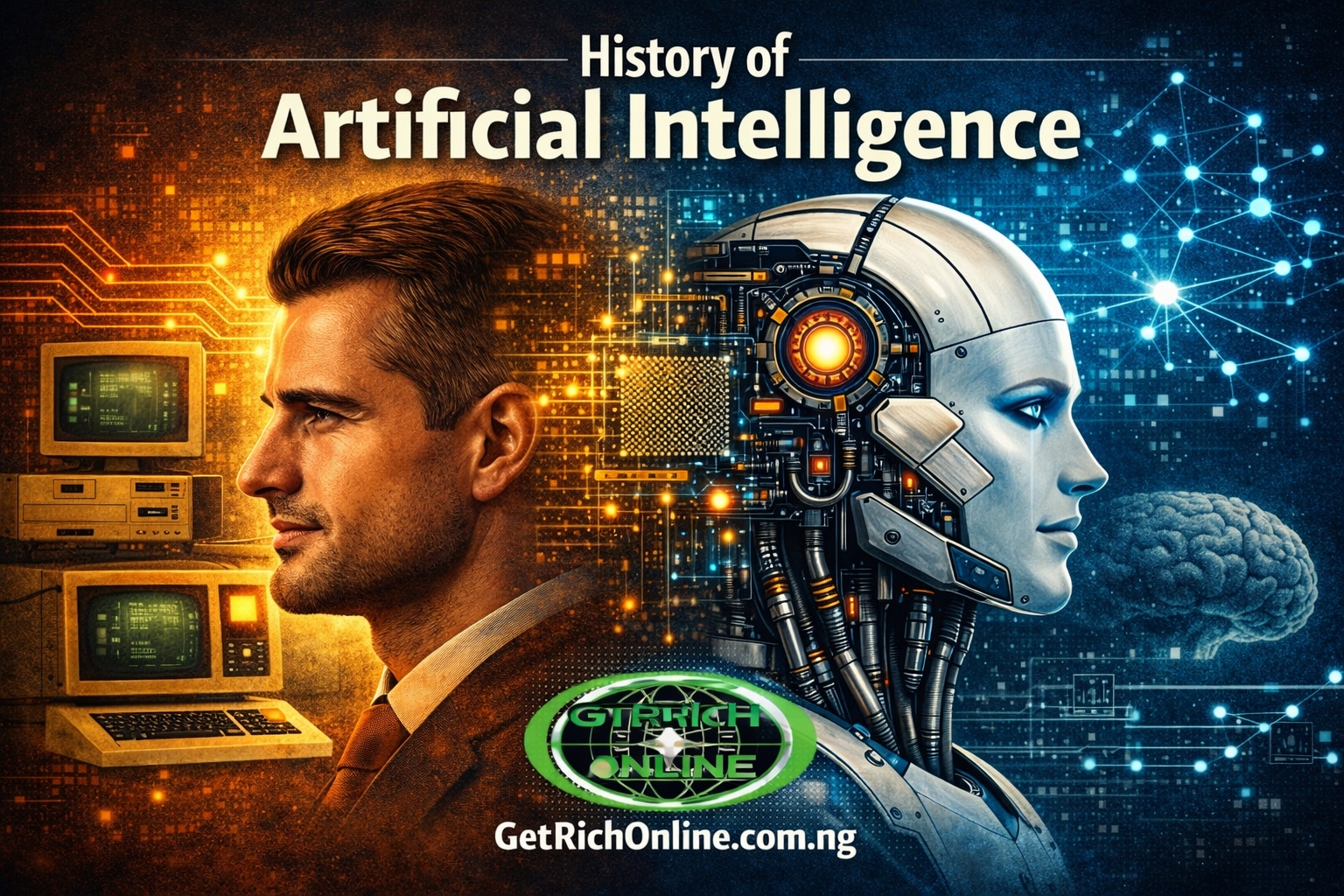
Understanding the Journey That Brought the World’s Most Powerful Income Tool to Every Nigerian’s Phone
It is 1950. The world is still recovering from the wounds of the Second World War. Nigeria is seven years away from independence, still under British colonial rule. In a quiet office at the University of Manchester, a thirty-eight-year-old British mathematician named Alan Turing picks up his pen and writes a question that will, seventy-two years later, change the income of a content creator in Lagos, a student in Enugu, and a trader in Kano.
The question is this: Can machines think?
At the time, computers occupied entire rooms, generated enormous heat, and could barely perform arithmetic reliably. The idea that a machine could one day think, reason, learn, and hold a conversation seemed like science fiction. Most of Turing’s contemporaries dismissed the question as philosophical nonsense. A handful of brilliant, stubborn researchers took it seriously — and the world has not been the same since.
Today, that question has an answer. It is in your pocket. Every time a Nigerian opens ChatGPT to write a business proposal, asks Claude to explain a contract clause, or uses Canva AI to design a flyer, they are living inside the answer to Alan Turing’s 1950 question. The technology that began in a wartime codebreaking hut in the English countryside has arrived — for free — on every Nigerian smartphone with an internet connection.
At Get Rich Online, our mission has always been to help Nigerians understand internet technology well enough to earn from it. We have established that AI is real, that it is already inside Nigerian banking, telecoms, education, and agriculture, and that it presents genuine income opportunities for every Nigerian willing to develop the right skills. But understanding what AI is today is only half the picture. Understanding where it came from — the decades of ambition, failure, survival, and breakthrough that produced the tools available to Nigerians right now — is what transforms a casual user into a strategic one.
This article tells that story in full. We wrote it for the Nigerian reader who wants to understand not just how to use AI, but why the moment we are in right now is so historically significant — and why acting during this window is one of the smartest decisions any income-focused Nigerian can make.
Why Every Nigerian Should Know the History of AI
History, in most conversations, is treated as something for classrooms and examinations. For AI, history is something else entirely. It is a strategic map.
Every income stream available to Nigerians through AI today — freelancing on Fiverr, building chatbots for Nigerian SMEs, creating digital products on Selar, running AI-powered content businesses — exists because of a specific sequence of events that unfolded over seven decades. Understanding that sequence tells you how the tools work, why they have the specific limitations they do, and where the next opportunities are likely to emerge before the crowd identifies them.
There is also a protective function to this knowledge. AI has been overhyped before — twice — and those hype cycles cost investors, researchers, and institutions enormous resources. Nigerians who understand the pattern of AI history are better equipped to distinguish genuine opportunity from inflated promises. In a country where online income trends are frequently exaggerated and exploited, that discernment is not just useful — it is financially protective.
Finally, understanding AI history builds trust in the tools themselves. When you know why ChatGPT sometimes gives wrong answers, why it is stronger in English than in Yoruba or Igbo, and why certain AI tools are free while others cost money, you use AI more intelligently. You stop being surprised by its limitations and start designing around them. That is the difference between a frustrated beginner and a productive earner.
What Is Artificial Intelligence? The Definition Every Nigerian Needs First
Before we trace the history, we need to agree on exactly what we are talking about. The phrase “Artificial Intelligence” is used so loosely in media and conversation that it has become almost meaningless without a clear definition. Let us fix that here.
The two words are simpler than they sound. Artificial means human-made — not natural, not organic. A plastic bottle is artificial. A synthetic wig is artificial. A photograph edited on Canva is artificial. Intelligence means the ability to learn, understand, reason, solve problems, and adapt to new situations. Put the two together and you arrive at a definition that is genuinely plain: Artificial Intelligence is a human-made system that can learn, understand, reason, solve problems, and adapt — the way a person would.
The most important word in that definition is learn. This is what separates AI from every computer programme that came before it. Traditional software is rigid. Every possible situation must be anticipated and programmed in advance. Think of it like a security gateman who has been given a strict list of ten approved names and told to let only those people in. If someone not on the list arrives — even if it is clearly the chairman’s wife — the gateman is stuck. His instructions only cover the ten names he was given.
AI is a different kind of gateman altogether. Instead of working from a fixed list, it learns from experience. Feed it millions of examples, and it finds the patterns connecting those examples. Once it has found enough patterns, it can handle entirely new situations it was never explicitly programmed for — the way a gateman with twenty years of experience and sharp judgment can make the right call even when the situation is unusual.
It helps to understand that AI, Machine Learning, and Deep Learning are not the same thing — though they are constantly used interchangeably. Think of them as three circles, one inside the other. AI is the outermost circle — the broadest concept, referring to any machine that mimics human intelligence in any capacity. Machine Learning sits inside that circle — it is a specific approach to building AI in which the system learns patterns from data rather than following manually coded rules. Deep Learning sits inside Machine Learning — it is the most powerful form, using mathematical structures loosely inspired by the human brain, called neural networks, to learn from enormous datasets. ChatGPT is Deep Learning. The face recognition unlocking your Nigerian smartphone is Deep Learning. The TikTok algorithm choosing which videos to show you next is Deep Learning.
With this foundation in place, the history of AI makes much more sense — because what you are really tracing is the seventy-six-year journey toward building systems capable of genuine, flexible, practical learning.
The Pre-History of AI: The Dream of Thinking Machines
The desire to create intelligent machines did not begin with computers. It did not even begin in the twentieth century. It is, in many ways, as old as human imagination itself.
Ancient Greek mythology described Talos — a giant bronze automaton built by the god Hephaestus to guard the island of Crete. Jewish tradition tells the story of the Golem — a humanoid creature brought to life from clay through sacred ritual. These were not engineering blueprints; they were cultural expressions of a persistent human question: can we create something that behaves like a thinking being?
The question moved from mythology to mathematics in the seventeenth century. Blaise Pascal built the Pascaline in 1642 — the first mechanical calculator, capable of addition and subtraction. It was a machine performing a cognitive task, and it was revolutionary. Gottfried Wilhelm Leibniz improved on Pascal’s work and, crucially, developed binary arithmetic — the system of zeros and ones that underlies every digital computer ever built, including the one or phone running the AI tools you use today.
Charles Babbage took the most significant pre-electrical step in the nineteenth century. His Analytical Engine — conceived in the 1830s though never fully constructed in his lifetime — had a memory, a processor, and could be programmed using punch cards. It was, in concept, the first general-purpose computer. Working alongside Babbage, Ada Lovelace wrote what are now recognised as the world’s first computer programmes and theorised that such a machine could, in principle, compose music and produce complex outputs far beyond arithmetic. She saw, two centuries ago, what we are only now fully realising.
George Boole completed the mathematical foundation in 1854 with his work translating human logical reasoning into mathematical equations — what we now call Boolean logic. AND, OR, NOT. Those three operations became the language of all digital circuits and, eventually, all AI. Without Boole’s work, there is no transistor, no microchip, no programming language, no artificial intelligence.
The dream of thinking machines, in other words, was not born in Silicon Valley. It was assembled slowly, across centuries, by mathematicians and engineers in Europe whose work Nigerians are now building income upon.
1936–1950: Alan Turing and the Birth of the Idea
Alan Turing was twenty-four years old in 1936 when he published a paper that most people in his era could not fully understand — and that the entire computing industry now regards as its founding document.
The paper introduced a theoretical concept called the Turing Machine — not a physical device, but a mathematical proof that a single, general-purpose machine could, in principle, compute anything computable. Every computer ever built — from the first university mainframe in Nigeria to the cloud servers running ChatGPT — is a physical realisation of the abstract machine Turing described in 1936.
During the Second World War, Turing led the team at Bletchley Park that cracked the Nazi Enigma cipher — the encrypted communication system the German military used to coordinate its forces. The machine they built to crack it, the Bombe, was the first large-scale electromechanical computing device applied to a real-world problem. Historians estimate that this work shortened the war by two to four years and saved millions of lives. It was the earliest proof that machine intelligence, applied to a complex problem, could produce outcomes that human intelligence alone could not.
Then in October 1950, Turing published the paper that launched everything we are discussing in this article. “Computing Machinery and Intelligence” opened with the question: Can machines think? Turing recognised that “thinking” was too philosophically contested to test directly. He proposed instead a practical challenge he called the Imitation Game — now known as the Turing Test. A human judge would have text conversations with both a human and a machine without knowing which was which. If the judge could not reliably tell them apart, Turing argued, the machine had demonstrated something we must call intelligence.
Turing predicted that by the year 2000, machines would pass this test in at least some meaningful contexts. He was approximately right. But he did not live to see it. In 1952, Turing was prosecuted under British law for being gay — a criminal offence at the time — and subjected to chemical castration as a condition of avoiding prison. He died in June 1954 at the age of forty-one. The father of computer science and artificial intelligence was treated as a criminal by the country whose war he had helped win.
In 2013, Queen Elizabeth II granted him a posthumous royal pardon. In 2021, his image was placed on the British £50 note. The Turing Award — computing’s highest honour, equivalent to the Nobel Prize — is named after him. His story is a reminder that the history of technology is inseparable from the history of human injustice — and that some of the most consequential minds in history worked under conditions of profound personal suffering.
1956: The Official Birth of Artificial Intelligence
Six years after Turing’s paper, in the summer of 1956, a small group of researchers gathered at Dartmouth College in New Hampshire for a two-month workshop that would officially name and define a new field of science.
The workshop was organised by mathematician John McCarthy, who coined the term “Artificial Intelligence” — deliberately choosing it to distinguish the new field from related disciplines. Alongside McCarthy were Marvin Minsky, Claude Shannon (the father of information theory), and Nathaniel Rochester of IBM. The proposal for the workshop contained a statement of extraordinary confidence: that “every aspect of learning or any other feature of intelligence can in principle be so precisely described that a machine can be made to simulate it.”
That confidence attracted research funding, drew talented minds into the field, and produced the first AI programmes — the Logic Theorist, which proved mathematical theorems, and the General Problem Solver, which attempted to create a universal thinking machine. Early results were genuinely impressive within narrow boundaries. Researchers began making ambitious predictions: that a machine would beat the world chess champion within ten years, that AI would solve most major human problems within a generation.
Those predictions were wrong. And that wrongness had consequences.
The First AI Winter (1974–1980): When the Dream Froze
By the early 1970s, the gap between what AI researchers had promised and what they had delivered had become embarrassingly wide. The early programmes worked brilliantly in small, controlled “toy” environments — proving theorems from a limited set, solving puzzles within a defined scope — but collapsed immediately when exposed to real-world complexity.
The fundamental problem was what researchers call the combinatorial explosion. As problems grew in size and complexity, the number of possible steps a programme needed to evaluate grew exponentially — far beyond what 1960s and early 1970s hardware could handle. Machine translation — one of the field’s most publicised goals — had produced systems that looked impressive translating short, simple sentences but produced gibberish on anything more complex.
In 1973, British mathematician Sir James Lighthill published a review commissioned by the UK Science Research Council. His conclusion was devastating: AI had failed to achieve its stated goals, had produced “grandiose claims,” and was unlikely to deliver on its promises. The report triggered a near-total collapse of UK government AI funding. The United States followed: DARPA dramatically reduced its AI budget, and many talented researchers abandoned the field entirely.
The First AI Winter had arrived. For the Nigerian reader, this period carries a lesson that transcends AI: the most important breakthroughs in any field are rarely destroyed by the first failure. They are temporarily buried under the rubble of misaligned expectations — and then rebuilt, more carefully, by the few who refuse to quit.
1980–1987: The Expert Systems Revival
AI did not stay frozen. It came back — in a different form, with a more pragmatic approach.
Rather than trying to build machines that could think about everything, researchers focused on building machines that could think very well about one specific thing. These were called Expert Systems — programmes that encoded the decision-making rules of human specialists in a particular domain: medicine, law, industrial engineering, financial analysis.
The most commercially successful was XCON, developed for Digital Equipment Corporation in 1980. XCON automatically configured computer system orders — a task that previously required experienced human engineers. It saved DEC an estimated forty million dollars per year by the mid-1980s and became the blueprint for an entire industry. By 1985, the Expert Systems market in the United States alone was worth over one billion dollars annually. Every major corporation — banks, manufacturers, insurance companies, defence contractors — was investing in AI.
In 1982, Japan’s government launched the Fifth Generation Computer Systems project — an $850 million, ten-year national bet on AI dominance. This triggered competitive anxiety in the United States and United Kingdom, where governments relaunched their AI investment programmes. For a brief, exciting period, it genuinely seemed as though AI had found its footing.
It had not. The seeds of the next collapse were already planted inside Expert Systems’ greatest strength: their rigidity. They could only handle situations explicitly encoded in their rules. If a situation arose that their programmers had not anticipated, they failed completely. They could not learn from new cases. They could not adapt. And maintaining them — updating their rules as the expert’s domain evolved — was crushingly expensive. The same brittleness that had killed the first wave of AI was hiding inside the second.
The Second AI Winter (1987–1993): The Collapse of Expert Systems
By 1987, the specialised hardware market built around Expert Systems collapsed almost overnight. General-purpose desktop computers — cheaper, faster, and more versatile — rendered dedicated AI machines obsolete. Hundreds of millions of dollars in corporate investment evaporated within two years.
This second Winter was more demoralising than the first because it ended commercial products that businesses had actually purchased and deployed — not just academic research programmes. The word “AI” became associated with failed promises in corporate boardrooms. Many researchers began describing their work using different vocabulary — “machine learning,” “knowledge engineering,” “computational intelligence” — simply to avoid the tainted label.
Japan’s Fifth Generation project was quietly wound down by 1992, having produced impressive academic work but nothing commercially competitive. DARPA cut funding again. The field contracted.
And yet — inside this second winter — the most important work in the history of AI was being done. A small group of researchers, working with minimal funding and almost no institutional support, continued refining a technology that had been largely abandoned: neural networks. Geoffrey Hinton, Yann LeCun, and Yoshua Bengio — later called the Godfathers of Deep Learning — kept building through the cold. Their persistence through the Second AI Winter is why ChatGPT exists today. The lesson for any Nigerian building a skill or business during a difficult period is direct: the breakthroughs that change the world are almost always assembled during the winters.
1993–2011: The Quiet Revolution — Machine Learning Takes Root
The fundamental shift that ended the AI Winters was philosophical, not just technical. Researchers stopped trying to programme intelligence by encoding rules — the approach that had failed twice — and asked a different question: what if we showed the machine millions of examples and let it find the patterns itself?
This shift from rule-based to data-driven AI is the most important conceptual transition in the history of the field. And the technology that made it possible at scale was not an AI invention at all. It was the internet.
The World Wide Web — made public in 1991 and exploding in scale through the mid-1990s — was the most consequential event in AI history that nobody called an AI event. It created the first freely available, continuously growing, massively diverse dataset in human history. Every website, every forum post, every news article, every product review was adding to the raw material from which AI would eventually learn. Nigeria got its first internet service providers in 1996. Nigerian voices, Nigerian culture, and Nigerian knowledge began entering the global dataset.
In 1997, IBM Deep Blue defeated world chess champion Garry Kasparov in a six-game match — the first time a computer had beaten a reigning world champion under standard tournament conditions. It was a landmark moment for public perception of AI. The important technical caveat is that Deep Blue was not learning — it was calculating, evaluating two hundred million positions per second through specialised hardware. It was sophisticated computation, not genuine machine intelligence. But the public lesson landed clearly: machines could outperform the best human minds at complex intellectual tasks.
Google’s PageRank algorithm, launched in 1998, was an early practical application of Machine Learning at internet scale — ranking web pages not by manually programmed criteria but by algorithmically learning which pages were most useful based on patterns across the entire web. By the time Google dominated search globally, hundreds of millions of people were already using AI every day without knowing it.
Through the 2000s, Machine Learning moved steadily from academic research into commercial applications: spam filters, credit scoring systems, product recommendation engines. Amazon’s “customers who bought this also bought” function — powered by collaborative filtering, an early Machine Learning technique — was generating substantial revenue by the early 2000s. All the while, Hinton, LeCun, and Bengio were quietly refining their neural network research, building toward a breakthrough the wider world would not see coming.
2012: The Deep Learning Breakthrough That Changed Everything
In 2012, a team led by Geoffrey Hinton’s PhD student Alex Krizhevsky entered a global image recognition competition called the ImageNet Large Scale Visual Recognition Challenge. Their entry was called AlexNet. The competition’s best systems at the time achieved error rates of around twenty-six percent — impressive, but still far from human performance.
AlexNet achieved an error rate of fifteen point three percent. Nearly half the error rate of the second-place entry. The gap was so large that some researchers initially assumed it was a mistake. When verified, it sent shockwaves through the entire AI research community. The modern era of Deep Learning had begun.
Three factors converged to make AlexNet possible — and understanding these factors explains why the current AI revolution is different from every previous wave. First, massive datasets: ImageNet provided fourteen million labelled images; the internet provided text and other data at even larger scales. Second, GPU computing: NVIDIA graphics cards, originally designed for video games, turned out to be ideal for training neural networks — reducing training times from months to days. Third, algorithmic improvements: decades of refinement by Hinton, LeCun, Bengio, and their students had produced neural network architectures capable of learning deep, hierarchical representations of data.
None of these three factors existed at the right scale simultaneously until 2012. When they converged, the field accelerated at a pace nobody had predicted. ChatGPT was released in 2022 — but its intellectual foundations were laid in this moment. Every major AI tool available to Nigerians today traces directly back to what AlexNet demonstrated on a competition dataset in 2012.
2014–2019: The Race Accelerates
The period between 2014 and 2019 produced four developments that together built the direct foundation of every AI tool Nigerians use today.
In 2014, researcher Ian Goodfellow introduced Generative Adversarial Networks — GANs. The concept was elegant: two neural networks compete against each other. One generates fake data — images, audio, text. The other tries to detect the fakes. Through competition, both improve. The generator learns to produce increasingly realistic outputs; the detector learns to identify increasingly subtle fakes. GANs are the foundational technology behind AI-generated images and, eventually, tools like Midjourney and DALL-E. They are also, in the wrong hands, the technology behind deepfake fraud — a reminder that every powerful tool cuts in both directions.
In 2015, OpenAI was founded as a non-profit AI research organisation, with a stated mission to ensure that artificial general intelligence benefits all of humanity. Its decision — years later — to release its tools to the public rather than keep them within a closed research environment is the direct reason ChatGPT eventually became accessible to a student in Ibadan.
In 2016, AlphaGo — built by DeepMind — defeated Lee Sedol, the world’s greatest Go player, four games to one. Unlike chess, the ancient board game Go has more possible positions than there are atoms in the observable universe. It cannot be beaten by calculation alone. AlphaGo had learned to play by playing millions of games against itself — using Reinforcement Learning. The move it played in Game Two, Move 37 — a move no human player would have made, initially judged wrong by experts, later revealed to be a stroke of strategic brilliance — demonstrated something genuinely new: AI had developed a form of strategic intuition that went beyond anything explicitly programmed into it.
In 2017, eight researchers at Google Brain published a paper titled “Attention Is All You Need.” It introduced the Transformer architecture — a new way of building neural networks that processes entire sequences of data simultaneously and learns which parts to “pay attention to” when generating a response. GPT, BERT, Claude, and Gemini are all built on Transformer architecture. Without this 2017 paper, there is no ChatGPT. It is, arguably, the most consequential research paper in the history of consumer technology.
November 30, 2022: The Day ChatGPT Changed the World
On November 30, 2022, OpenAI released ChatGPT as a free web application. The interface was deliberately simple: a text box. Type anything in plain language. Receive a response.
One million users in five days. One hundred million users in two months. No consumer technology in recorded history had grown that fast. Instagram took two and a half years to reach one hundred million users. TikTok took nine months. ChatGPT did it in sixty days.
What made ChatGPT different from all the AI that came before it was not primarily its technical capability. GPT-3 — the underlying model — had been available to developers via API since 2020. The difference was accessibility. A simple text box in a web browser, free to use, requiring no technical knowledge, no coding background, no special account. For the first time in the history of AI, the most powerful language AI in existence was available to anyone who could type.
That included Nigerians. ChatGPT spread through Nigerian WhatsApp groups within days of its launch. University students in Ibadan and Zaria immediately began using it for assignments. Entrepreneurs in Lagos and Abuja began exploring its commercial applications. Content creators in Port Harcourt and Enugu began experimenting with AI-generated scripts and articles. Within weeks, tutorials about ChatGPT in Pidgin English, Yoruba, and Hausa were circulating on Nigerian social media.
What followed was a wave unlike anything the technology industry had produced before. Google launched Gemini. Anthropic launched Claude. Meta released its open-source models. Microsoft embedded AI across Word, Excel, PowerPoint, and Windows. By the end of 2023, over five thousand new AI tools had launched across every professional category. The revolution that Alan Turing had imagined in 1950 had arrived — and every Nigerian with a smartphone had a front-row seat.
2023–2026: The AI Revolution in Full Swing
We are currently living inside the most consequential phase of AI development since the field was named. The tools available today are not the tools that will be available in two years — and that trajectory matters enormously for income-focused Nigerians.
The defining development of this era is multimodal AI: systems that process and generate across text, images, audio, and video simultaneously within a single conversation. A Nigerian accountant can photograph a handwritten receipt, upload it to Claude, and ask it to extract the figures, calculate the totals, and format a table — all in one message. A Lagos-based entrepreneur can describe a product concept in text and receive a photorealistic image of it within seconds. These are not future capabilities. They are available today.
AI agents represent the next significant shift. Where current AI tools answer questions and generate content, AI agents take actions — browsing the web, writing and executing code, managing calendars, sending emails, and completing multi-step tasks with minimal human direction. For Nigerian freelancers and business owners, this means AI that does not simply advise but executes — handling the repetitive operational tasks that currently consume time that could be spent on higher-value work.
AI tools for video generation — Sora, Runway, and others — are making professional-quality video production accessible without a camera crew. Nigerian YouTube creators and content businesses that previously could not afford production costs are building audiences with AI-generated visuals. AI coding tools like GitHub Copilot are making software development faster for trained developers and accessible to non-technical builders. Microsoft Copilot embedded across Office tools is changing how Nigerian corporate professionals work with data, documents, and communication.
Nigeria’s own AI ecosystem is growing. AI-powered startups are emerging in health diagnostics, agricultural advisory, and credit scoring. Nigerian universities are beginning to incorporate AI into their curricula. And the Get Rich Online AI Training Group is part of the grassroots movement ensuring that AI literacy reaches Nigerians across every state, not just those in proximity to elite institutions.
The History of AI Monetization: From Research Labs to Nigerian Phones
Understanding how AI went from a multimillion-dollar government tool to a free application on a Nigerian’s phone is not just interesting history — it is the economic context that explains why the income opportunities available today are real.
The earliest AI was funded almost entirely by defence contracts. Turing’s wartime codebreaking work, DARPA’s research programmes, the UK defence budget — these were the primary patrons of AI in the 1950s, 1960s, and 1970s. The general public had no access and no way to benefit. Expert Systems in the 1980s became the first commercial AI products, but only corporations with very large budgets could afford them. A single Expert Systems implementation cost hundreds of thousands of dollars. Individual Nigerians, regardless of their resources, could not participate.
Through the 1990s and 2000s, AI became invisible infrastructure — embedded inside search engines, spam filters, and recommendation algorithms. Nigerian users of Google and early e-commerce platforms were already benefiting from AI as embedded infrastructure, without knowing it or being able to deploy it themselves. The 2010s introduced AI as a subscription product: Grammarly, Salesforce Einstein, IBM Watson — AI-powered tools priced at $10 to $50 per month, designed primarily for US and European markets.
The API economy opened the door for Nigerian developers. From 2015 onward, OpenAI, Google, and others began offering AI intelligence via API — allowing anyone, anywhere, to plug world-class AI into their own products without building it from scratch. Nigerian fintech companies like Carbon and Branch began using AI APIs for credit scoring and fraud detection. Then ChatGPT arrived in 2022, and the final barrier — technical knowledge — was removed entirely.
Today, the income streams available through AI include the following. AI freelancing — offering AI-powered services on Fiverr and Upwork, where a Nigerian writer delivering ten AI-assisted blog articles per week at twenty dollars each earns eight hundred dollars monthly from a phone and a data subscription. AI digital products — e-books, prompt packs, and mini-courses created with AI assistance and sold on Selar and Gumroad, generating income from a product built once and sold indefinitely. AI content businesses — niche blogs, faceless YouTube channels, and paid newsletters powered by AI, generating passive income through advertising and affiliate partnerships. AI agency services — Nigerian entrepreneurs building and selling AI implementation packages to Nigerian SMEs, priced from fifty thousand naira for a simple chatbot to five hundred thousand naira or more for comprehensive automation.
The gap between AI as an exclusive corporate tool and AI as a free application on a Nigerian’s phone closed in approximately seventy years. That closure happened because computing became cheaper, the internet became universal, and AI companies chose accessibility over exclusivity. The Nigerian who acts during this mass monetization phase — before AI skills become standard requirements rather than competitive advantages — is in the most strategically advantageous position in the entire history of AI access for ordinary people.
The Future of Artificial Intelligence: What Is Coming and What It Means for Nigeria
The current AI revolution is not the end of the story. It is, by any reasonable assessment, still the beginning. The developments on the near horizon will create income opportunities that do not yet fully exist — and forewarned Nigerians will be best positioned to capture them.
Artificial General Intelligence — AGI — remains the declared long-term goal of organisations like OpenAI and Google DeepMind. AGI refers to an AI that can understand, learn, and apply intelligence flexibly across any intellectual task a human being can perform, without needing specific retraining for each new domain. No AI system today is AGI. The most advanced tools available right now — ChatGPT, Claude, Gemini — are sophisticated Narrow AI operating across a wide range of language tasks. The timeline for AGI is genuinely contested: Sam Altman has suggested it could be years away; Geoffrey Hinton estimates five to twenty years; other credible researchers believe it remains decades out. What is clear is that the income opportunities available today do not require waiting for AGI. What is in Nigerian hands right now is already sufficient to transform incomes.
The improvement of AI in Nigerian languages is a development with direct national significance. Current AI performance in Yoruba, Igbo, and Hausa is improving but remains significantly below English performance, primarily because the training datasets in Nigerian languages are much smaller. Organisations like Masakhane — an African natural language processing research community — and Meta AI’s multilingual projects are actively working to close this gap. As they succeed, AI tools will become accessible to Nigerians who are more comfortable in their first language than in English, dramatically expanding the potential user base.
AI in Nigerian healthcare, agriculture, and education carries transformation potential that goes beyond individual income. AI diagnostic tools for tuberculosis, malaria, and diabetic retinopathy are already being piloted in Nigerian hospitals — critically important in a country where trained radiologists are concentrated primarily in Lagos and Abuja. AI crop disease detection and weather prediction tools are reaching smallholder farmers in Benue and Kaduna who have no access to agricultural extension officers. AI tutoring platforms are beginning to personalise learning for Nigerian students in ways that classroom sizes and teacher shortages currently prevent.
The jobs that AI will create in Nigeria over the next decade do not yet fully exist. AI Trainer — providing feedback to improve AI models’ responses to Nigerian-specific content. AI Integration Consultant — helping Nigerian SMEs implement AI tools into their operations. AI Ethicist — advising organisations on responsible AI deployment. AI Content Strategist — a professional role in large Nigerian businesses. Each of these roles requires a combination of AI literacy and domain expertise that Nigerian professionals are building right now through training programmes like the Get Rich Online AI Training Group.
The warning that must accompany this optimism is direct. The window of competitive advantage for AI early adopters in Nigeria is real but not permanent. Within three to five years, AI proficiency will be a baseline expectation in Nigerian corporate hiring, freelancing, and entrepreneurship — not a differentiator. The Nigerian who builds these skills now will be positioned ahead of that expectation when it becomes universal. The Nigerian who waits will be starting from zero in a crowded market. The tools are free. The training is free. The barrier to entry today is the lowest it will ever be.
Common Myths and Misconceptions About AI in Nigeria
Several widely held beliefs about AI are preventing talented Nigerians from engaging with opportunities that could transform their financial lives. These beliefs deserve direct, honest responses.
The most damaging myth is that AI is only for educated tech people. This is factually incorrect. The most powerful AI tools available today — ChatGPT, Claude, Canva AI, Chatbase — are operated through simple text boxes and menus that require zero technical knowledge. The most important AI skill, prompt engineering, is a communication skill. A Nigerian market trader who communicates clearly with customers already possesses the foundational capability for effective prompt writing. Formal education is an advantage, not a prerequisite.
The second myth — that AI will take all Nigerian jobs — misrepresents the real picture. AI will automate some tasks, transform many roles, and create new categories of work. The jobs most at risk are those built entirely on repetitive, rule-following tasks. The accurate competitive divide is not AI versus Nigerians — it is AI-skilled Nigerians versus AI-unskilled Nigerians. Precisely as ATMs changed what bank tellers do without eliminating the role entirely, AI will reshape professional work rather than simply deleting it.
The third myth is that AI is too expensive for Nigerians. ChatGPT, Claude, and Gemini all offer generous free tiers. Canva AI is free at its foundational level. The majority of tools covered in the Get Rich Online AI Training Group are completely free to use. A Nigerian can build real skills, create real products, and generate real income on free tools before spending a single naira.
The fourth myth — perhaps the most dangerous for practical use — is that AI always tells the truth. AI models generate plausible-sounding responses based on learned patterns. They do not “know” facts the way a reference book contains facts. They can and do produce confident, grammatically perfect, completely wrong answers — a phenomenon called hallucination — especially on specific Nigerian legal, medical, and regulatory details. The safety practice is straightforward: use AI as a brilliant first-draft generator and research accelerator, and verify specific facts, statistics, legal information, and medical details from authoritative Nigerian sources before acting on them. This is not a reason to avoid AI — it is a reason to use it wisely.
Frequently Asked Questions
Who is considered the true father of Artificial Intelligence — Alan Turing or John McCarthy?
Both figures have strong claims to the title, and the distinction is worth understanding. Alan Turing is widely regarded as the father of computer science and the foundational thinker who first asked whether machines could think — his 1950 paper and the Turing Test defined the central question of AI. John McCarthy is credited with coining the actual term “Artificial Intelligence” at the 1956 Dartmouth Conference and with establishing it as a formal academic field. If Turing asked the question, McCarthy named the field dedicated to answering it. Most researchers acknowledge both contributions rather than choosing between them.
What were the AI Winters, and could they happen again?
The AI Winters were periods — the first from approximately 1974 to 1980, the second from 1987 to 1993 — in which AI research funding, public interest, and institutional investment collapsed following the failure of the field to deliver on its promises. They happened because researchers made predictions that their technology was not yet capable of fulfilling, and because the hardware and data infrastructure required for the breakthroughs they imagined did not yet exist. A third AI Winter is possible but considered less likely than the first two, because the current revolution is grounded in demonstrated commercial value — billions of paying users, trillion-dollar corporate valuations — rather than purely academic promise. Understanding the pattern, however, protects the Nigerian reader from acting on inflated claims about AI capabilities.
What exactly is the Turing Test and has any AI ever passed it?
The Turing Test, proposed by Alan Turing in 1950, is a practical challenge in which a human judge communicates by text with both a human and a machine without knowing which is which. If the judge cannot reliably distinguish the machine from the human, the machine has passed the test. Several AI systems have claimed to pass versions of the Turing Test under specific, controlled conditions — most notably a chatbot called Eugene Goostman in a 2014 competition — though these claims are widely disputed because the conditions were narrow and the conversations brief. What is more accurate to say is that modern AI systems like ChatGPT and Claude can sustain conversations indistinguishable from human writing in many contexts, while still failing on others. The Turing Test remains a useful conceptual framing, even if the full philosophical question it was designed to address remains open.
What is the Transformer architecture and why does it matter for the tools I use?
The Transformer architecture is the mathematical framework underlying virtually every major AI language tool available today, including ChatGPT, Claude, Gemini, and BERT. Introduced in the 2017 Google Brain paper “Attention Is All You Need,” it processes entire sequences of data simultaneously rather than step by step, and learns which parts of an input to prioritise when generating a response. This allows it to understand context across long passages of text far more effectively than previous architectures could. In practical terms for a Nigerian user: the reason ChatGPT can write a coherent ten-paragraph article maintaining consistent logic and tone throughout — rather than losing track of what it said three sentences ago — is the Transformer architecture.
How does understanding AI history help me make money from it today?
Understanding AI history gives you three practical advantages. First, it explains why current tools have the specific strengths and limitations they do — which makes you a more effective user. Second, it shows you the pattern of AI development: each breakthrough creates new tools, new tools create new income streams, new income streams create new categories of skilled workers. Recognising where you are in that pattern tells you which skills to build before the market prices them in. Third, it helps you distinguish genuine long-term opportunities from short-term hype cycles — a distinction that has protected fortunes and wasted them in equal measure throughout AI history. The Nigerian who earns most from AI will not necessarily be the most technically skilled. They will be the most strategically informed.
Conclusion: History Is Not the Past. It Is the Map.
You have just walked through seventy-six years of the most consequential technological development in human history — from Alan Turing’s question in a Manchester office to the AI tool generating income for Nigerians across every state today.
Let us trace what we have covered together. Turing asked whether machines could think in 1950. McCarthy named the field at Dartmouth in 1956. The first wave of optimism collapsed in the First AI Winter of the 1970s, revived through Expert Systems in the 1980s, and collapsed again in the Second AI Winter of the early 1990s. A small group of researchers kept building through both winters — and their persistence produced the Deep Learning breakthrough of 2012 that started the current revolution. GANs, AlphaGo, the Transformer architecture, and GPT-3 followed in rapid succession. On November 30, 2022, ChatGPT made the most powerful AI in history available to anyone with a smartphone. Within days, it was in Nigerian WhatsApp groups. Today, it is generating income for Nigerians on Fiverr, Selar, Gumroad, and through their own blogs and agencies.
That is not a story about technology. That is a story about a window — a window that opens when a powerful tool becomes accessible before most people understand how to use it, and closes when everyone catches up. Nigeria is currently inside that window.
The three decisions that will determine whether this article changes your income or simply becomes another interesting read are direct. First, join the free Get Rich Online AI Training Group — the structured, beginner-to-professional curriculum taking you from foundational AI understanding through to income-generating skills across ten modules. Second, bookmark getrichonline.com.ng and return for the full companion tutorials that accompany every module and every topic in the training. Third, identify one income stream from the monetization history section of this article and take the first concrete step toward it within the next seven days — not after you feel fully ready, not next month, but this week.
AI is reorganising the global economy. The Nigerians who understand where it came from know where it is going. And where it is going is where the next generation of Nigerian business leaders, professionals, and creators will build their futures.
You read this entire article. That already places you ahead of the majority. The history has been told. What you do with it is entirely yours to decide.
Published on Get Rich Online — Nigeria’s Internet Monetization Destination.
Join the Free AI Training Group · Read Full Module Tutorials at getrichonline.com.ng

Leave a Reply